“Write everyday“, that’s what I said I would do. It’s really hard. So much to say, no order to the thoughts. Some connect, others are off on their own, untethered and unlikely to return.
So this is an attempt to create some structure, a bit of momentum, and maybe even a repository for all the types of value witnessed along the way. It’s also a way of sharing the experience, connecting with others and living the values of transparency and participatory research.
Back to University – How did this happen?
Last time I was a student was in the 1994, studying Sport and Tourism at Staffordshire University. I lived for the hockey team, I met some of my best friends, I fell in love and went on to weave a life involving all of the above. As I cycled to the Advanced Wellbeing Research Centre at Sheffield Hallam University to join my new teammates a few months ago, I realised that not much has changed. I’m 50, still live for sport and anything active, still have so much to learn, and continue to flourish amongst the energy of others.
A PhD was never on my radar. I consider myself more of a doer – seeking out practical ways to enable people to come together, get things done, grow, and develop. My chosen channel was sport and physical activity, but in recent years I have explored nature, music, and more general community organising and network weaving as a means of generating knowledge, skills, understanding, respect and collective power.
When a friend put the PhD opportunity at Hallam in front of me and suggested I apply, I laughed – a lot. I’m not an academic, a scholar or a researcher, and I really can’t bear detail. But after wrestling with imposter syndrome for several nights, I reached the conclusion that this might be a time for me to contribute to the world in a different way. What if I could use my experience to deeply understand and explore how to measure the value of community led development work in a way which reflects what matters to people and communities, and improves the status of the VCFSE sector in system work?
And here we are, 6 months into a 3 and a half year PhD. Well, that’s the plan!
Unanswered questions
Witnessing community growth is both a privilege and a source of curiosity and I have seen it through a multitude of lenses. Directly in my own community as a participant and organiser, through a Community Interest Company (CIC) working at neighbourhood level, through a Local Authority, a County Sport Partnership and more recently though an Integrated Care Board. Whatever the perspective, certain questions remain:
- What if we measured the value of the VCFSE sector by the things that really matter to people and communities? (the relationships, the connection, the belonging, the pride, the humility, the rawness of being vulnerable alongside each other)
- What if we stopped counting beans and instead deeply understood and witnessed the difference community led activity made to people’s lives?
- What if the relationship between VCFSE sector providers and funders/commissioners/policy makers was one of collective transformation rather than transaction?
Questions for Research
These questions have become drivers in shaping the title, aim and working objectives of my research and over the coming weeks, months and years I will be writing about this journey. I will start by exploring the context we’re operating in, the concepts of value, measurement, and the Voluntary, Community, Faith and Social Enterprise Sector (VCFSE). I will explain why I have chosen to use ‘value’ over ‘impact’ as an anchor to this work and move on to consider the range of stakeholders involved in assessing the value of the VCFSE sector.
In academic terms, I will consider the following research questions (although they may change along the way).
Primary Research Question:
What approaches to measuring VCFSE sector value work for whom, in what circumstances and why?
Secondary Questions:
- How is ‘value’ understood by different VCFSE sector stakeholders?
- What measurement approaches are currently used to understand VCFSE sector value, and how do they differ in their ability to recognise formal metrics as well as informal, emergent, narrative or relational evidence?
- What contextual factors influence the usefulness of different measurement approaches?
- What mechanisms explain stakeholder engagement with measurement, particularly when value creation is fluid, informal, or resistant to codification?
- Under what circumstances do measurement approaches generate evidence that stakeholders consider credible, useful, and actionable when the underlying value is transformational rather than transactional?
- How does the act of measuring value itself shape, constrain, or disrupt VCFSE sector practice?
Realist Evaluation Methods
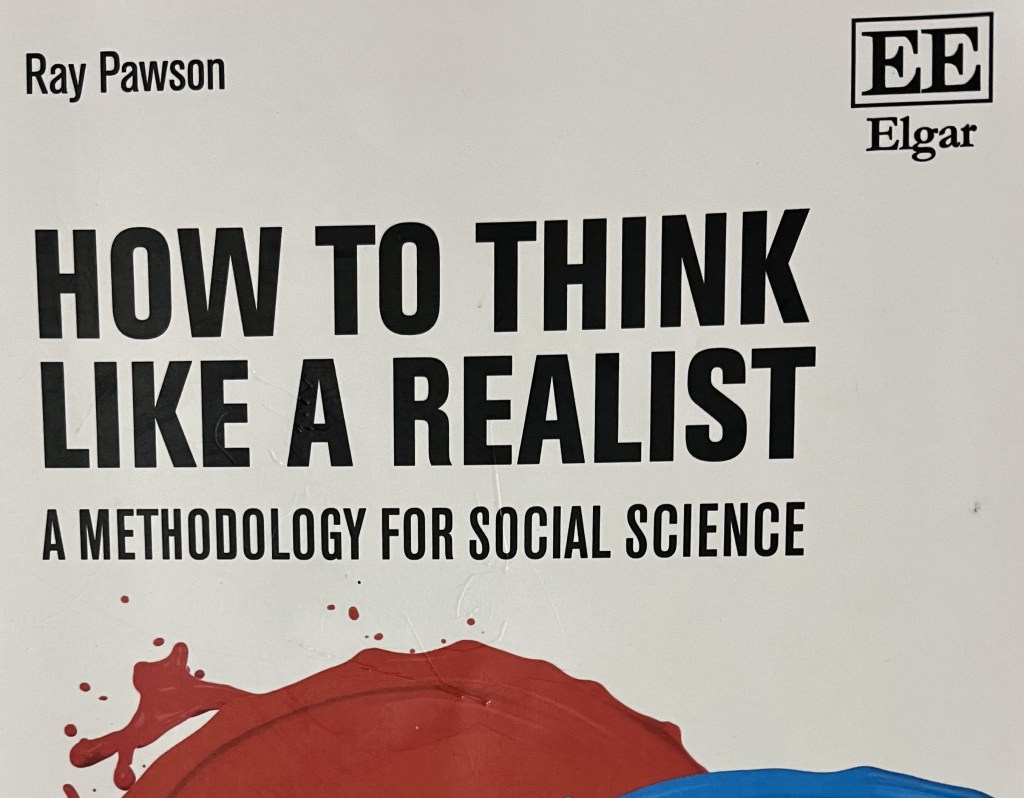
I’ll be using Realist evaluation methodology throughout the PhD. Although still very new to me, it already makes a lot of sense as it assumes that different interventions work for VCFSE organisations in different contexts. It is a theory-based evaluation approach developed by Pawson and Tilley in the mid 1990s which embraces complexity and deals with the messiness of life in the round. Perfect for this work. Rather than asking simply ‘what works’, realist approaches use programme theories to explain and explore what works for whom, in what circumstances and in what respect.
Next Steps
Writing, I hope will become a regular practice and already feels more achievable now that this is live. As the research deepens to focus on emerging theories based on literature, stakeholder and lived experience input and my own hunches, there will likely be much to share and deliberate.
Contact Me
If this research is of interest to you, you would like to share feedback or you would like more information, please get in touch a.kemp@shu.ac.uk

