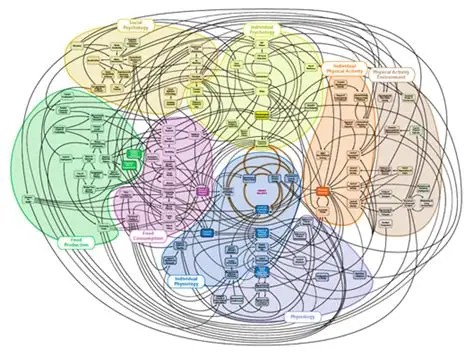
One of the joys of being a scholar is being able to think more deeply about the things that have bothered me over the years – such as power imbalances in systems work, marginalised groups being overlooked or excluded from decision making, and the gap between well intentioned strategy and the reality of implementation. Getting behind some of these issues requires more than random exploration, and certainly for this research I am looking for methods and tools I can use to help structure the enquiry.
Tools and Frameworks
In seeking such frameworks, I was excited to come across Critical Systems Heuristics and Boundary Critique which may offer just what I need right now. Having worked in opposing ends of the health system – the formality of commissioning at one end and the mud and bullets of community provision at another, I am familiar with the application of ‘systems thinking’ and what it offers by way of mapping the complexities of interactions, connections, relationships and patterns across the whole system. However, if my research is to meaningfully measure value in the VCFSE sector, one of the key tasks will be to explore beyond what is going on in the system and to examine who defines the system, whose interests count, whose definitions of value are privileged and with what consequence.
Critical Systems Thinking
Critical Systems Theory combines systems thinking with critical social theory, recognising that systems are not neutral and that power, values (what matters to people), and marginalisation influence how problems are framed. Acknowledging this within place-based deliberation would, I believe, go a long way to ironing out some of the unspoken tensions which naturally arise in this type of work.
Critical Systems Thinking asserts that there is no ‘God’s Eye View’ of a whole system and all its connectivity, therefore any view is only ever partial or selective, that is, part of the whole and serving some parties better than others. Gerald Midgley, a British Organizational theorist and professor of systems thinking notes that partiality is unavoidable, inherently limited or restrictive, and informed by values.
“No specific proposal, no decision, no action, no system can get a total grip on the situation and get it right for everyone” (Reynolds 2008).
To me, it feels humble and refreshing to approach systems work with a shared recognition of partiality, accepting together that none of us has the whole picture in sight and recognising that the way a system is structured places some organisations in a more favourable position than others.
This is important because in exploring the value of the contribution of the VCFSE sector to an integrated system, we need to remember that the system does not simply exist, waiting to be observed, but it emerges from the boundaries we choose and construct.
Critical Systems Heuristics (CSH)
Critical systems heuristics, (Ulrich 1983) is a philosophical framework or discovery tool to support reflective practice. They offer a way to examine how we frame situations, how we understand assumptions and the multiple perspectives people bring, as well as those which may be missing.
In relation to place-based or neighbourhood work, CSH could open up an opportunity for revealing and promoting wider stakeholder interests, particularly those of small or medium sized VCFSE organisations. As a framework, it should prompt a critical awareness among those involved in projects as to what interests are given prominence and which others are marginalised, as well as suggesting ways in which participatory planning and evaluation might be more inclusive and balanced.
Critical Systems Heuristics seek to understand what is going on behind a system, project or intervention and are distinct from Systems Thinking in the following ways:
| Systems Thinking | Critical System Heuristics |
| How does the system work? | Who decided what the system is? |
| Focuses on relationships and feedback | Focuses on boundaries, values and power |
| Seeks better understanding of complexity | Seeks more reflective and legitimate decision making |
| Models the system | Questions assumptions behind the model |
| Improvement orientated | Improvement plus critique of whose improvement matters |
Boundary Judgements and Critique
We are constantly drawing distinctions about what is relevant, what is less important, who matters and who does not, what counts as success etc. These assessments, also known as ‘boundary judgements’ form a kind of reference system which underpins our decision making in everyday life. Boundary Critique is a systematic way of handling boundary judgements critically.
Ulrich (1983) proposes 4 basic boundary issues which are central for reflective practice in most situations of problem solving, decision making or professional intervention:
- Sources of Motivation
- Sources of Power
- Sources of Knowledge
- Sources of Legitimacy
Boundary Questions
The purpose of boundary questions is to surface and reflect on our assumptions and to uncover a range of alternative contexts that might matter to us or others. Again, this seems to be a useful approach to make time for with stakeholders from the outset of a project, before roles, perspectives and positioning emerge by default. Boundary questions may also be a useful starting point to explore measuring value in the VCFSE sector; what is the purpose, who benefits and what counts as value?
Questions of Motivation
Questions to help unfold or unearth deeper understanding of motivation for measuring value might include:
- ‘What is the ideal purpose of a measurement system?’
- ‘Who are the intended beneficiaries?’
- ‘In what way might measurement be coercive rather than emancipatory?’
- ‘Who are the victims of the measurement system?’
Questions of Power
Questions to help unfold or unearth deeper understanding of power when measuring value might include:
- Who is in a position to change the measurement of value?
- Who is making decisions about what is valued or not important?
- What resources are controlled by the decision maker?
Questions of Knowledge
Questions to help unfold or unearth deeper understanding of knowledge when measuring value might include:
- Who is considered an expert provider of knowledge (participant, lived experience etc)
- What counts as relevant knowledge or expertise?
Questions of Legitimacy
Questions to help unfold or unearth deeper understanding of legitimacy when measuring value might include:
- Who is witness to the interests of those affected but not involved? That is, who is treated as a legitimate stakeholder, and who argues the case of those stakeholders who cannot speak for themselves, including future generations, the environment etc.
- What secures the emancipation of those affected?
- What different visions of ‘improvement’ are being considered?
So, I have a few more tools in my belt! And they seem to be central to developing theories about which value measures work for whom, in what circumstances and how. Frameworks such as these might also support a new level of mutual understanding and tolerance in dealing with the often-unspoken tensions inherent in place based work.
Through boundary reflection, perhaps we can achieve a new quality of self-reflection and through boundary discussion, a new quality of communication in and about interventions.


Leave a Reply